+86-18537111511
xsb001@yusenn.com
Language
中文简体
English
Русский
Español
Home
Products
Yusenn heating
Yusenn cooling
Integrated thermal management system
Business environment control
Parts
Solutions
Bus system
Truck system
Engineering vehicle system
Car system
RV system
Tent system
OEM ODM Service
About Us
Company Profile
Development History
Qualification Honor
Production Equipment
Blog
Notice announcement
Company dynamics
Industry information
FAQ
Download
Contact Us
knowledge
2025.06.25
Can energy storage thermal management liquid-cooling units replace air cooling?
In energy storage systems, air cooling and liquid cooling are the two mainstream approaches for thermal management. However, in recent years, liquid-cooled units have gradually become the industry’s focal point due to their unique advantages. So, can liquid-cooled units for energy storage thermal management replace air-cooled ones?
2025.06.24
Energy-storage liquid-cooling units: A robust barrier to mitigate thermal runaway risks
The efficient heat dissipation characteristics of energy-storage liquid-cooling units are key to mitigating the risk of thermal runaway. Thanks to their high specific heat capacity, the coolant can rapidly absorb the substantial heat generated by the battery. Meanwhile, a circulating pump delivers the coolant between the cold plate and the heat exchanger at a stable, adjustable flow rate, ensuring that heat is swiftly removed from the battery system.
2025.06.23
Industrial and Commercial Energy Storage Thermal Management: The Secret Weapon for Boosting Industry Efficiency
Explore industry solutions for thermal management in commercial and industrial energy storage, enhancing energy efficiency and promoting sustainable development.
2025.06.21
Exploring the Working Principle and Applications of Methanol Heaters
Let’s delve deeper into the working principle, advantages, and diverse applications of methanol heaters, and together uncover the secrets behind this intriguing piece of equipment.
2025.06.20
Working Principle and Operational Flow of PTC Water Heaters for New Energy Vehicles
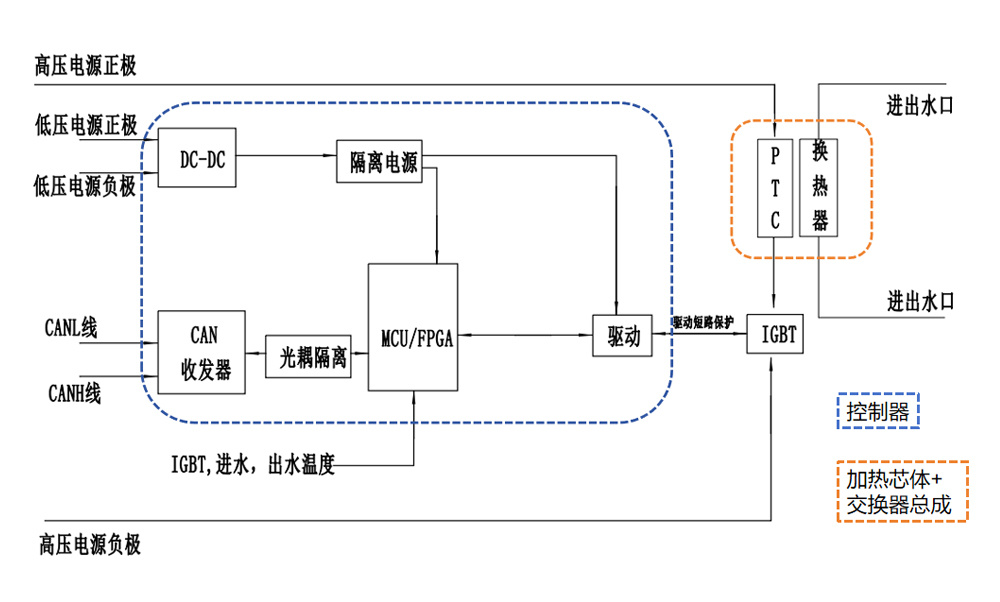
After receiving the vehicle’s operation command and temperature requirements, the PTC water heater determines whether heating is necessary based on the difference between the desired temperature and the current water temperature, then activates the PTC control system accordingly. Throughout the process, the heater continuously monitors whether the actual water temperature has reached the target level. Once the target temperature is achieved, the heater either reduces its power output or stops heating altogether.
Analysis of the Working Principle of PTC Electric Water Heaters in New Energy Commercial Vehicles