

News Center
Blog
The Low-Temperature Startup Revolution for Methanol Engines – Methanol Engine Preheating System
Release time:
2025-08-27
The technological breakthrough in methanol engine preheating systems is addressing the challenge of cold-start difficulties in methanol engines through "precise temperature control and efficient empowerment," enabling a rapid transition of methanol engines from cold to peak performance—and serving as a critical support for the commercialization and real-world application of methanol-powered technology.
In the global wave of transitioning energy systems toward cleaner alternatives, methanol has emerged as a highly promising alternative fuel for internal combustion engines, thanks to its wide availability, low carbon emissions, and safe storage and transportation. However, methanol's unique physical properties—such as its significantly lower latent heat of vaporization (about three times that of gasoline) and higher freezing point (-97.8°C, though viscosity rises markedly at extremely low temperatures)—pose substantial challenges during the cold-start phase of methanol engines. These challenges include "difficult vaporization, weak combustion, and increased wear," which not only hinder the engine's ability to start reliably but also lead to higher fuel consumption, excessive emissions, and sluggish power response during startup. Fortunately, breakthroughs in methanol engine preheating technology are now addressing these critical issues by enabling "precise temperature control and efficient energy delivery." This innovation is accelerating the transition of methanol engines from cold-state performance to peak efficiency, making it a crucial enabler for the commercialization and widespread adoption of methanol-powered vehicles.
I. The Challenge of Cold-Start Performance in Methanol Engines
When the ambient temperature drops below 10°C, the starting challenges of a methanol engine gradually become apparent. And if the temperature falls below -20°C without auxiliary heating, the methanol engine may even find itself stuck in a "completely unstartable" situation. The core issue lies squarely within three key dimensions:
First, the methanol vaporization efficiency is insufficient. During cold starts, components such as the cylinder block, pistons, and intake passages are at extremely low temperatures. As a result, when methanol is injected, it struggles to vaporize quickly, instead easily forming a "liquid oil film" that adheres to the cylinder walls and intake passage surfaces. This not only leads to uneven mixture concentrations in the combustion chamber—resulting in locally lean or rich areas—but also causes "oil-film loss," where some of the methanol fails to participate in combustion, directly reducing overall combustion efficiency. In extreme cases, this can even trigger the "wet-wall phenomenon," significantly increasing the risk of机油稀释.
Secondly, high oil viscosity leads to a decline in lubrication efficiency. At low temperatures, engine oil viscosity increases significantly— for instance, 5W-30 oil becomes more than 10 times thicker at -20°C compared to 20°C—making it difficult for the oil pump to quickly deliver the thickened oil to critical friction points such as the crankshaft, camshaft, and piston rings. This results in an extended period of "dry friction" during the initial cold-start phase. Data shows that wear during the cold-start phase accounts for over 60% of the engine's total wear, and frequent cold starts under prolonged low-temperature conditions can significantly shorten the engine's lifespan.
Third, the combustion stability is poor, leading to a delayed power response. Due to insufficient vaporization of the air-fuel mixture, the flame propagation speed within the combustion chamber slows down during cold starts, resulting in a low ignition success rate. Even if the engine does manage to start successfully, it may still experience idle抖动 and significant RPM fluctuations. To maintain stable operation under these conditions, the ECU (Electronic Control Unit) increases the fuel injection volume—known as "enrichment compensation." This not only causes the fuel consumption during the startup phase to surge by 30% to 50% compared to normal operating conditions but also leads to the incomplete combustion of methanol, generating higher levels of formaldehyde and unburned hydrocarbons (HC), among other pollutants. As a result, the emissions fail to meet the stringent requirements of China VIb and higher emission standards.
These challenges not only affect user experience but also stand as a major "obstacle" to the widespread adoption of methanol engines in high-latitude, frigid regions—such as Northeastern and Northwestern China. In these colder areas, early methanol-powered commercial vehicles without heating systems often had to rely on labor-intensive and potentially hazardous methods during winter, like "baking the car" (using flames to heat the oil pan) or "adding gasoline to assist startup." Such practices are cumbersome and pose significant safety risks, severely limiting the large-scale application of methanol-based power systems.
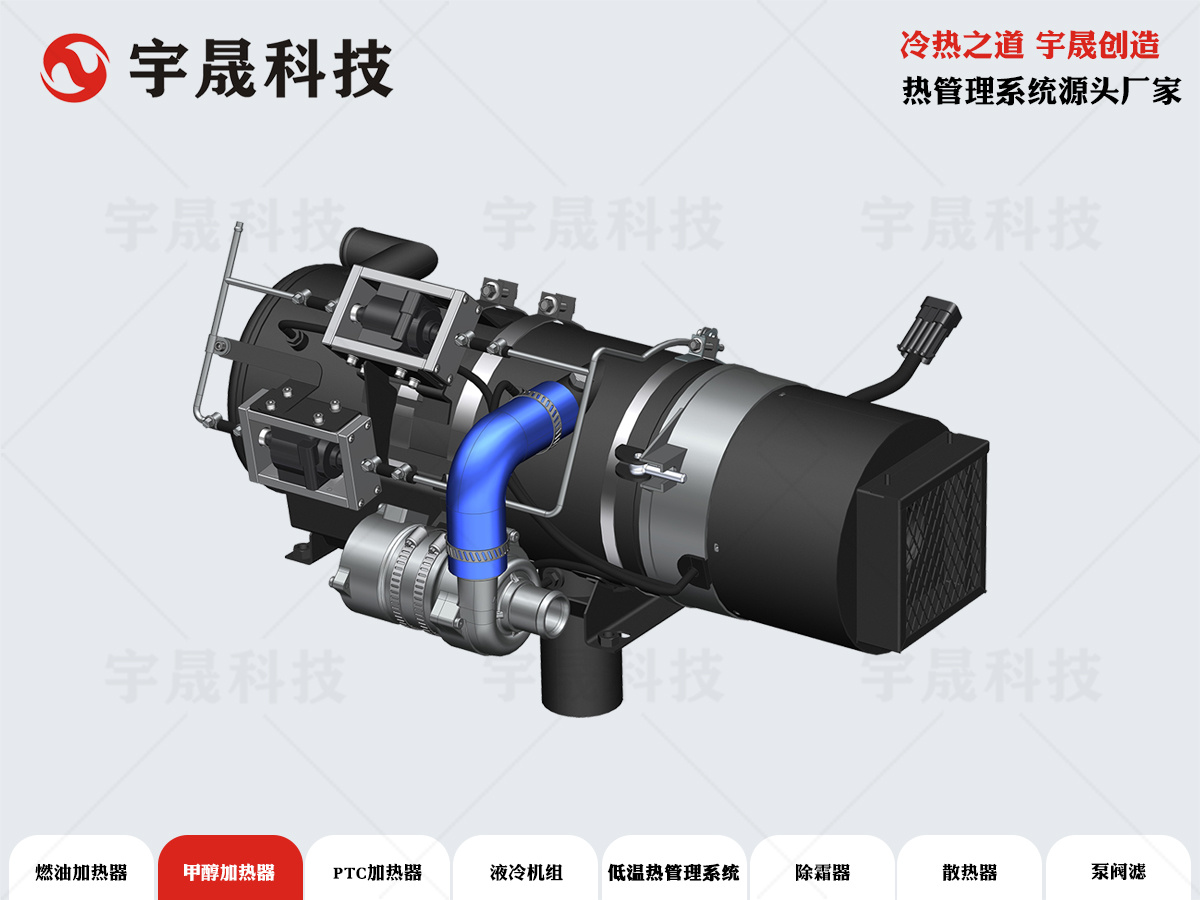
Yusheng Technology is a manufacturer of methanol heaters, independently developing and producing various models tailored for diverse applications—including methanol-fueled commercial vehicles, methanol engines, and methanol generator sets. If you happen to have specific needs for methanol heaters, Zhengzhou Yusheng Technology is undoubtedly a reliable choice for you.
↓↓↓ Scan the "Customer Service WeChat QR Code" at the very bottom of the scan page to get the technical specification sheet for methanol heaters, as well as personalized solutions for methanol engine preheating systems.
Latest News